
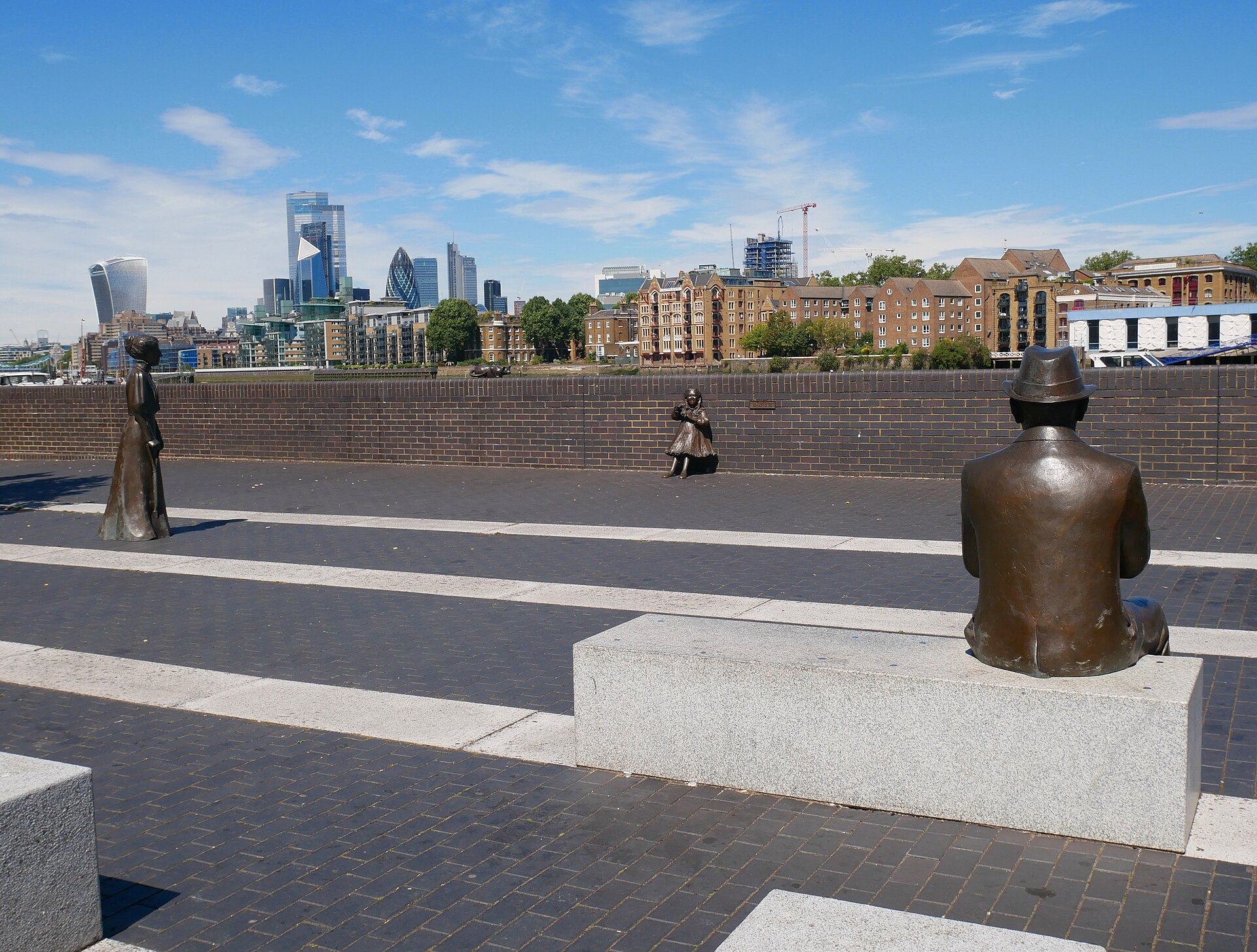
Featured image: ‘Dr Salter’s Daydream’ by Ethan Doyle White, CC BY 4.0, via Wikimedia Commons.
Last month, London Link teenage Quakers gathered for a residential weekend at Forest Hill Meeting House in south London – and one afternoon took them on a journey back into one of the most remarkable chapters in the borough’s history.
Guided by local Quaker Sheila Taylor, the group walked the streets of Bermondsey to trace the lives of Ada and Alfred Salter: a couple who, driven by their Quaker faith and a fierce sense of social justice, set about nothing less than transforming one of the most deprived corners of Victorian and Edwardian London.
Who were Ada and Alfred Salter?
When Ada Brown arrived in Bermondsey in the late 1890s as a social worker, she found a neighbourhood of crushing poverty: overcrowded slums, rampant disease, and streets without a single tree. It was there that she met Alfred, a doctor who had turned his back on a comfortable Harley Street career to set up a surgery in a converted shop on Jamaica Road, where he treated poor patients for little or nothing. As his friend and political ally Fenner Brockway later wrote, their partnership on Jamaica Road “brought something little short of a revolution to Bermondsey and its people.”
They married in 1900 and both committed to the Society of Friends, becoming Quakers. Their faith was inseparable from their politics. They helped found the Bermondsey branch of the Independent Labour Party, and Alfred created in miniature an “NHS before the NHS,” importing the latest medical clinics and facilities into the borough.
Ada became Mayor of Bermondsey in 1922 – one of the first female mayors in the country – the first ever female Labour mayor. In the same year Alfred was elected Labour MP for Bermondsey West. From these positions they drove through an ambitious programme: slum clearance, new cottage-style housing estates, vastly improved sanitation, and Ada’s beloved Beautification Committee, which had planted 7,000 trees on the new estates and streets of the borough by 1930.
Their personal tragedy makes their public achievements all the more extraordinary. Their daughter Joyce, born in 1902, was adored throughout Bermondsey. Locals called her “our little ray of sunshine.” In 1910, aged just eight, she caught scarlet fever during an epidemic and died. Ada’s sadness never quite left her; it was in her eyes and in her expression all through the years. And yet both threw themselves still deeper into their work. The grief they experienced spurred them further on to improve conditions in the area.
London Link Group’s Step Back in Time
The group’s tour began at Wilson Grove, the cottage estate Ada designed for working-class families each home built to a standard almost unimaginable for Bermondsey at the time, with a living room, scullery, bathroom, hot and cold water. From there they walked to the Thames riverfront, where the Salter statues stand. The sculpture, known as “Dr Salter’s Daydream,” depicts the family at a happy time in their lives. It has its own troubled history: the original statue of Alfred was stolen in 2011, presumed melted down for scrap metal. The community raised £60,000 to replace it, and at the same time a statue of Ada was added, recognising that she was very much a figure worth honouring in her own right.
The walk ended in Southwark Park, with a picnic lunch in the Ada Salter Garden, a fitting place to rest among the trees and flowers that Ada fought so hard to bring to her neighbourhood.
Remembering the Salters
The Quaker Socialist Society runs the annual Salter Lecture – a highlight of our Birtain Yearly Meeting. Each year a speaker is invited to address themes of social justice, equality, and conscience, values that Ada and Alfred embodied throughout their lives. Past lecturers have included politicians, activists, and environmental thinkers, keeping the Salters’ spirit of principled, faith-rooted radicalism alive into the present day.
Leave a Reply