Author: Guest User

  • Learning from our past as we build our future: when Six Weeks Meeting became LQPT

    Learning from our past as we build our future: when Six Weeks Meeting became LQPT

    At a time of significant change for our Area Meeting structures, the former Clerk of Six Weeks Meeting reflects on a previous period of transition: when Six Weeks Meeting became London Quakers Property Trust.

    Six Weeks Meeting (SWM) was registered as a company limited by guarantee in 2009, and the name was changed to London Quakers Property Trust (LQPT) in 2017. The trustees of SWM chose this legal framework because there was no other option at the time; registering it as a Charitable Incorporated Organisation wasnโ€™t possible until 2013. This was also the clear advice of our solicitors, Russell Cooke. 

    SWM had been set up by George Fox in 1671 and continued for over 300 years with no legal status. Britain Yearly Meeting (BYM), like many old-established religious bodies, had excepted charitable status and had no charity number. Because several religious bodies and charities misused their funds in the 1980s, the government rightly decided that all religious bodies and charities had to be legally established, registered, and under the eye of the Charity Commission, so BYM itself, all our Area Meetings, and SWM, had to regularise their status.  Setting up LQPT took years of work from trustees and staff – days in the Library checking all the historic deeds of every meeting house, many many meetings with solicitors, letters and phone calls to and from the Charity Commission, consultations with AMs, trustee meetings, and hours and hours drafting snd re-drafting minutes so that the new Trust was soundly based.  We felt that whatever changes might come to LQPT in the future, this gave it a solid foundation. 

    If now in 2026, we in London had decided to set up a CIO from scratch, we would have been asking for years of voluntary work and high solicitors fees. The Charity Commission was fairly slow in my time; it now has more work and fewer staff, so the process would be even slower. It will be for QiL and QiL trustees to discern whether changing the legal status to become a CIO is worth the effort at some time in the future, recognising that it will be a long-drawn-out process.

    Submitted by a Former Clerk to Six Weeks Meeting

  • Elders and Pastoral Carers Committee Report on its First Year

    Elders and Pastoral Carers Committee Report on its First Year

    Dugan Cummings, Clerk to EPCC reports on what the Committee has been up to in its first year.

    A year ago it was decided to set up a committee of Elders and Pastoral Carers to serve Joint London Area Meeting (JLAM). The intention was to seek experienced people from each of the Area Meetings in London, plus someone from Young Friends, to provide:

    • Eldership and Pastoral Care during JLAM and subsequently QIL in session
    • support to other Elders and Pastoral Friends in Local Meetings (LMs) (including ensuring that support is provided from outside a LM in times of difficulty). This may include training, helping to build mutual support groups and responding to ideas for strengthening Eldership and Pastoral Friend work
    • gatherings of all Elders and Pastoral Friends from across London Area Meeting at least once a year.

    We were asked first to consider ways into membership. Quaker Faith and Practice (chapter 11) sets out principles and gives guidance but allows flexibility in how area meetings implement them. The seven current London AMs have each developed their own practices. As we come together, we have an opportunity to agree on a shared approach, drawing on the best of existing practice, but ultimately creating something exciting and new, future-facing, and suitable for the new Quakers in London.

    We gathered leaflets on applying for membership and on what ought to be done when visitors are appointed to meet with an applicant. Not all the AMs in London had them. Together we marked up what seemed to us to be best practice and drafted new leaflets for JLAM to consider at its meeting in March. Friends present that day felt they needed more time to consider the issues and that will be done when JLAM meets in October. The EPCC paper on QiL Membership Process is available here.

    We were also asked to draw up a job description for the new Membership Clerk. It was encouraging to learn that clerical support would be provided for this role.

    In November 2025 Elders and Pastoral Carers across London were invited to spend a day at Friends House getting to know one another and thinking about how they carried out their responsibilities. This was so popular we planned another day together on 11July to consider the new relationship between JLAM and local meetings, support for smaller meetings, and support for families, children and young people. There were 40 of us, led by Josh Selfe in the morning and Julia Stacey in the afternoon. Friends were encouraged to write their questions and ideas on post-it notes and Josh collated them. They have drawn attention to areas of further work we need to do, including:

    • How will the EPCC support Elders and Pastoral Carers in Local Meetings? We think it might be helpful to draw up a list of Es and PCs with appropriate experience which we could draw on to support meetings with difficulties.
    • How can we learn from those meetings that are thriving and keeping their newcomers? We are seeking to collect their initiatives so they can be passed on to other meetings to help them โ€˜grow wellโ€™.
    • Can we provide training for new Elders and Pastoral Carers in London? We are exploring how this might be run with help from Woodbrooke. It could be very useful to people newly appointed to these roles and would also help them to get to know one another.

    We have met online 10 times so far and we have also provided Eldership at JLAM meetings, both in the room and on-line. We enjoy meeting together and trying to discern the way forward for QIL. There are only 8 of us on the committee and we have asked Nominations Committee to find us some more Friends to share the burden of our responsibilities at this key time in the development of Quakers in London.

    Dugan Cummings, Clerk to JLAM EPCC

    You can contact all of the QiL Committees on the contact page of this website.

  • Celebrating the Past In Transition

    Celebrating the Past In Transition

    A Friend from South East London Area Meeting reflects on how SELAM are commemerating the past as they take their final steps toward London Area Meeting.

    In SELAM we plan to commemorate the laying down of our AM; at our final meeting this year each of our three Meetings will present an item showing the flavour of each Meeting, and we will hear some stories from the past history of Quakers in the area, including the origin of each of the Meetings. ย  ย 

    From the early days we recall the destruction of Horsleydown meeting house,ย and our past includes famous Quakers like Ada and Alfred Salter, so we have a lot to celebrate.ย 

    If you would like to tell Friends about how your AM is approaching the transition, please feel free to get in touch by emailing us at quill@quakersinlondon.org.

  • British Quaker, American Friend: Reflections on BYM from across the Atlantic

    British Quaker, American Friend: Reflections on BYM from across the Atlantic

    Teran Chapis: British Quaker; American Friend, shares an extract of their report to Hartford Monthly Meeting in Connecticut, United States regarding Britain Yearly Meeting (BYM), which took place over four days in May.

    A recurring theme in conversations between Friends [at BYM] was our different understandings of God. Friends identified themselves as atheist or theist Quakers, and asked each other about their individual unique beliefs. One Friend from North Scotland said goodbye to me in the wee hours of Saturday morning by passionately declaring that I should minister the next day because: โ€œI am excited to hear the Lord speak through you.โ€ When he left the room I thought about it for a moment and said: โ€œHe doesnโ€™t believe in God.โ€ 

    At Meeting for Worship at Friends House the Sunday before Yearly Meeting, a Friend ministered that when she described a conference about God to a fellow Quaker, where a group of Friends organised all their thoughts about how they understand God as a concept, he asked her: โ€œWell does God understand you as a concept? Does God believe in you?โ€

    The following evening, on the walk home from a British Sign Language event, a Friend asked me โ€œwhy are you crying?โ€ 

    And I told them: โ€œI promise these are happy tears. Iโ€™ve just been thinking about how you said tonight that you donโ€™t believe in God because you donโ€™t believe that help will ever come. Because people like you are my proof of God. You are the help that came. You, my Friend, are my evidence for God.โ€ 

    I thought about the ministry that I had heard at Friends House the previous morning, and told them: โ€œMaybe asking the right question is more important than having the right answer. Maybe the question isnโ€™t whether or not we believe in God, but whether or not people see God in you.โ€ 

    And through a combination of American Sign Language, British Sign Language, lip reading, telepathy, and hugs, we cried and discussed this as we made the trek home through the dark and the rain of North London.

    It felt like a prank from the universe when my first Deaf friend after studying ASL uses British Sign Language. But Iโ€™m slowly relearning to sign with a different grammar structure and with lip patterns. When learning to sign BSL with fellow signing Friends in London, I learned that 1.) the request for a sign language interpreter at Britain Yearly Meeting this year was denied, and 2.) there arenโ€™t widely used official signs for the word โ€œQuakerโ€ or Quaker concepts. To fill in the gaps, we signed โ€œQuakerโ€ by shaking the BSL fingerspelling sign for Q, or sometimes, inspired by the name and profile picture of a Quaker groupchat, we use the BSL sign for geeseโ€ฆ meaning โ€œQuacker.โ€ 

    When I recounted the events of BYM to a lowercase f-friend, he said that once again, the strangest coincidences seem to happen to me. Years ago, before I ever stepped foot into a Quaker meeting, developing a disability inspired me to spend some forced sick time studying ASL. Little did I know what I was really preparing for.

    Inspired by conversations at Britain Yearly Meeting 2026, I am currently researching the history, experiences, and signs used by Deaf and signing Friends in Britain and the United States (including hearing, nonverbal Friends), and working on research proposals for research masterโ€™s/fellowships to conduct a formal study. If anyone is interested in connecting with me about this topic, or connecting with Deaf/signing Friends, donโ€™t hesitate to reach out to me at teranriley@gmail.com!โ€

    – Teran Chapis

    London Young Adult Quaker Meeting, Young Friends in Britain

    Inspired to attend Yearly Meeting? Yearly meeting now takes place over multiple sessions, with the most recent having taken place in Manchester last month. The last session for 2026 scheduled for 21 November in London. You can register to attend here: https://www.quaker.org.uk/ym/bookings. We hope to see you there!

  • Friends House Childrens Meeting: an update and upcoming vacancy

    Friends House Childrens Meeting: an update and upcoming vacancy

    This article is a contribution from our Friend Lucy Dodgson, who is the current Children and Young Peopleโ€™s worker at Friends House Meeting.

    Friends House Childrenโ€™s Meeting is an opportunity for young Quakers to gather, create, and engage with topics in the spirit of the Quaker Testimonies. Held in the Elizabeth Fry Suite of the lovely Friends House building, we welcome all participants aged 0-18 every (yes, every) Sunday of the month!

    As some Friends may know, our Childrenโ€™s Meeting had to go on a brief hiatus this past Winter, but I am happy to report that we are back up and running and we are thriving! Since February we have welcomed many young people through our doors, both London-based, and visiting Friends.

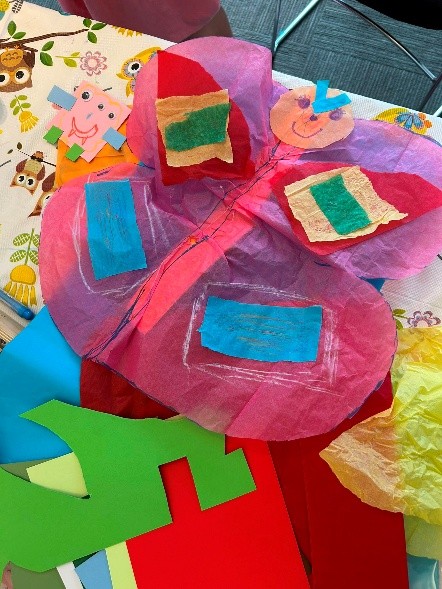
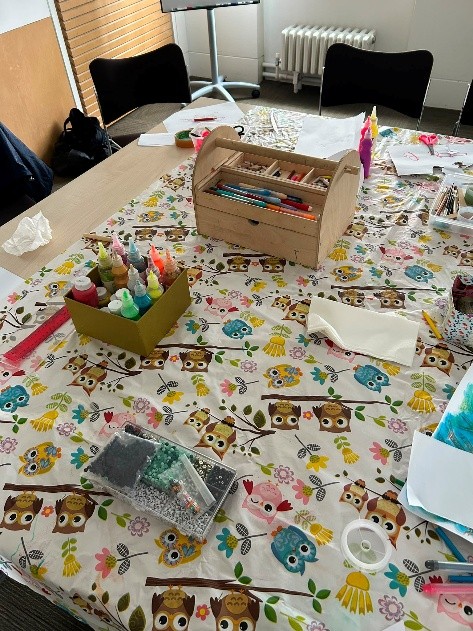
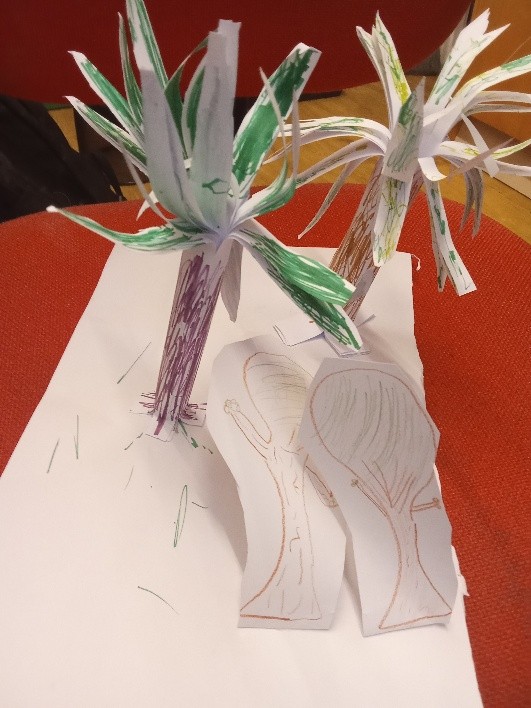
    We have had easter egg hunts, written stories, made friendship bracelets, painted, coloured and generally got very messy, all in the spirit of loving exploration. Suggestions from participants on themes and activities are key; we are building a meaningful community here, where everyone has a say.

    Fh Childrens Meeting Art Pink Butterfly 1
    Childrens Meeting Art – Pink Butterfly
    Fh Childrens Meeting Art Supplies
    Childrens Meeting – Art Supplies
    Fh Childrens Meeting Art Palm Trees
    Childrens Meeting Art – Palm Trees

    Some upcoming topics for the next couple of months include โ€œTake the adults for a walkโ€, โ€œA puppet showโ€ and making things with clay. We warmly welcome any who would like to join us, and you can contact cypworkerfh@gmail.com to be added to the mailing list, to be kept up to date on what activities are happening when.

    While I am delighted to tell everyone about our wonderful Childrenโ€™s Meeting, it is with a heavy heart that I also announce that I will be leaving London later this year and so there will soon be a vacancy for the (paid) role of Children and Young Peopleโ€™s worker at Friends House. The Meeting would very much like to hear from anyone interested in taking up the role. The job description is attached below, and in the meantime please do reach out to the Clerks at FHMClerk@outlook.com or me at cypworkerfh@gmail.com to enquire about the nature of the role or express interest. The rate is ยฃ20 per hour.

    The deadline for applications to this role is 23 August 2026 (although this may be extended as needed)

  • Changes in the Responsibilities of Local Meetings within Quakers in London

    A paper has been prepared by the Governance SubGroup of the London Development Group, bringing together the work of many Friends, to give a summary of how Local Meetings will work within a single London-wide Area Meeting.

    At the end of 2026, the seven current Area Meetings of London will merge with each other and with London Quakers Property Trust, to form Quakers in London (QIL). After that, the 33 Local Meetings will continue to operate in much the same way as now, guided by chapter 4 of Quaker Faith and Practice. This paper sets out the few exceptions, where there will be changes in how things work. Most of these are changing either because the new Area Meeting will be much bigger than our current ones or because QIL will provide a little more staff support to Local Meetings than currently. As LMs vary in the details of how they do things, the degree of change for each LM, compared with current practice, will also vary.

    This paper covers the following areas:

    • Local Business Meetings
    • Clusters
    • Local Nominations Committees
    • Eldership and Pastoral Care
    • Membership
    • Finance and Treasurers
    • Premises
    • Outreach
    • Community and Witness work
    • Provision for Children and Young People
    • Safeguarding
    • Advice to Friends on funerals
    • Care of burial grounds
    • Websites and IT

    Read and download the Changes in the Responsibilities of Local Meetings within Quakers in London paper, below:

  • Reflection on Helping Run London Quakers

    Reflection on Helping Run London Quakers

    A reflection from our Friend Fred Ashmore

    We laid down London Quakers after our last QiL Meeting for business on 13 June and approved the final annual report.  So, no more mailings, no more conversations with Friends House hospitality, no more flyers furtively scattered around the cafe, no more smiling Friends arriving with โ€œwas I supposed to registerโ€.

    Closing down included archiving a set of the Annual Reports from the beginning in 2011 until now.ย How nostalgic that was. If youโ€™re interested you can have a look at them at this linkย  Annual Reports. ย  They included lots of familiar themes and thoughts such as chaplaincy, death and dying, sex gender, racism, reparations. ย A good proportion of these were the meetings that went into pulling together the present Quakers in London and its structures.ย  LQ has run 7 or 8 gatherings for the Quakers of London every year for 12 years and each and every one of those was organised for you by some Friend or several Friends. Best of luck going forward!ย Iโ€™m going to find a deck chair.


    Without London Quakers, Quakers in London will miss lots of the incredible service that Friends gave to help build our London Wide community. The baton has been passed! If you’d like to organise or create something for London Friends, please contact QiLAC arrangements@quakersinlondon.org.

  • Quakers in London welcomes Jane-Eve Straughton as new Executive Secretary

    We’re delighted to announce that Jane-Eve Straughton has been appointed Executive Secretary of London Quakers Property Trust (LQPT), and will become Executive Secretary of Quakers in London (QiL) from January 2027. She joins us on 14 September, and Friends will have the chance to meet her at JLAM on 12 September.

    Some of you will already know Jane-Eve. She’s a member of NETAM, where she serves as a Local Meeting clerk, and many will have encountered her through her work heading one of the governance teams at Quakers in Britain.

    Jane-Eve brings a wealth of not-for-profit leadership experience, including as Executive Director of English Touring Opera and in other opera administration roles. Across her career she has built staff teams, managed substantial budgets, served as Company Secretary, supported strategy development, and ensured good governance. She holds a Diploma in Law and a degree in French and Russian, and while living in Norway was part of the clerking team at Oslo Monthly Meeting.

    As Executive Secretary, Jane-Eve will lead the staff team, oversee the maintenance and development of our meeting houses, and support trustees and the network of committees that keep London Quaker life running.

    A thorough and considered process

    This appointment followed a rigorous and carefully run recruitment process, with many strong candidates including Quakers, people from other churches, other faiths, and of no faith.

    We’re grateful to the Friends who gave their time to the recruitment panel, drawn from across London Quakers: six Area Meetings, LQPT trustees, Young Adult Quakers, the London Development Group, BYM trustees, QiL Nominations, QiL Arrangements Committee, and QiL Clerks (several wearing more than one hat).

    As Beth Allen writes in Quaker faith & practice 8.24, “We need to be an ordinary well-run organisation, with good structures, and sensible practices, which we then make extraordinary by transcending not discarding them.” We believe Jane-Eve will help us do exactly that.

    Caroline Nursey, Clerk LQPT Trustees and Member of London Development Group

  • News from JLAM: Latest Steps in Creating Quakers in London

    News from JLAM: Latest Steps in Creating Quakers in London

    On Saturday 13 June, the Joint London Area Meetings met at Westminster Meeting House to agree more steps towards becoming a single AM: Quakers in London (QiL), slated to take place in just over six months time. 

    With the help of QiL Co-Clerk Kate Green, we provide a summary of the morning and afternoon sessions and the thoughtful, creative, and constructive ministry that was heard.

    The minutes are also available to read and download here.

    Morning Session: How Should QiL Use its Money?

    The morning session was an open exploration around money. This is how one of our Clerks, Kate Green, summarised the lively discussion:   

    “We asked ourselves the question, โ€œHow should QiL use its money?โ€

    As single spiritual and financial body, how may we make the strongest impact in our Quaker, and the wider London, community? 

    Are we still as adventurous and far-sighted as earlier
    Friends were in using money for community benefit?

    It was a time for exploring our joys, fears and hopes for QiLโ€™s use of money, held in a spirit of worship. For the first time in London our meeting houses and our financial resources will be united. We need to discover our shared vision and what we are led to do, even when economic prospects are poor. Ministry started with references to Marie Kondoโ€™s philosophy. As we gradually evolve into Quakers in London, we need to examine all we do, all our traditions. Does this bring us joy? If it doesnโ€™t, thank it for its service and let it go.

    With the seven London AMs pooled resources, we hope to be able to more ethically manage our investments. Using the model of the Quaker Housing Trust, QiL could give grants, or lend money to other charities who share our testimonies and are doing the work we are led to do but arenโ€™t able to. We need to use all our connections with like-minded groups of people to discover what we may do together. We may also be led to contribute more than the minimum QiL quota, and to offer more service.

    Friends ministered about supporting Quaker children and young people (which may be as simple as giving them their own room in a Meeting House) and the need for a London Quaker Centre which is accessible to all.

    We also heard ministry about Reparation, the Climate Crisis, the Quaker Prison Ministry and the needs of Londonโ€™s young people in relation to violent crime.

    At the end of our session, we were all moved by the realisation that weโ€™re living in a historic time for Quakers in London. After the hard work of moving towards the merging of the seven London AMs, it was a discovery of our fundamental unity, and great hope for our future.”

    You can read more detail about this ministry in the document below:

    The Afternoon Session: Appointments, Membership, Discernment.

    In the afternoon session, key appointments were made, seven members of our community came into membership, and crucial financial decisions were taken.

    This meeting appointed JLAM’s interfaith representative, the QiL Membership Clerk, and a new member to the Elders and Pastoral Carers Committee. We also appointed six QiL “trustees in waiting”, who will begin their trusteeship on the first of January 2027.

    To get to know our community better, we are publishing introductions of trustees in waiting, role holders and community members over the course of 2026. This edition, we get to know two future trustees: George Barrow and Mary Stiasny.

    We also heard how the QiL finances will work and made the decision to maintain AMs existing designated funds for five years, then review.

    Additionally, two upcoming events which will help us continue our journey toward QiL were highlighted – one for Elders and Pastoral Friends on 11 July at Friends House and another on zoom on 29 July open to everyone to explore gaps in our present structure and how to fill them.

    We give our heartfelt thanks to all those who helped to make the day a success!

    Read and download the minutes below:

  • Reflections on Yearly Meeting: Bunhill Fields

    A member of Bunhill Fields Meeting attended Yearly Meeting and kindly provided this report. Are you still reflecting on Yearly Meeting? We’d love to hear your thoughts quill@quakersinlondon.org.

    Yearly Meeting session in May 2026 had main sessions onย ‘What unites us as a Spirit-led community?’ย and a following oneย ‘As a Spirit-led community, how can we handle conflict well?’.

    There was a lot of ministry both in Friends House and online. The main aspects I picked up were the need for us to be open minded, kind (without condescension), accept everyone’s views, listen attentively, recognise that there are language difficulties with other Quakers and other faiths, know that the Spirit moves through us (but isn’t us), recognise that we can feel battered and vulnerable, and that the fruits of the Spirit are action. We need to find opportunities to describe our feelings on God (which could involve singing). A wonderful analogy was given that when we look up through the tree canopy God is the light flowing through the leaves – we and the leaves are finite, but God is infinite light and indescribable.

    What I took away from these sessions is that language for all of us is so important, but slippery and difficult, and doesn’t always communicate well. By chance in the Bookshop I found Jane Pearn’s 2017 booklet on The Language of Leadings, a reflection on faith, action and concern. It is the result of an Eva Koch scholarship looking into the important Quaker idea of Concern. This is a wonderful introduction to slippery language and investigates Quaker thinking on the two main Yearly Meeting sessions. I have bought three copies for Bunhill Library which I hope newcomers will find helpful.

    Paul Parker, Recording Clerk, serves as the most senior staff member for the Britain Yearly Meeting, managing staff and supporting meetings. He acts as the senior staff member, often representing the Quaker community on public and social issues. He gave a comprehensive report on the many recent challenges Quakers have faced on the right to protest. Most recently on 21 April 2026 Quakers warned a parliamentary committee that sweeping restrictions on protest are putting British democracy at risk and preventing people from acting on their faith. Several Friends have been charged and imprisoned, with a peaceful Just Stop Oil protester still in prison. This is ironic in the year that we have laid down Meeting for Sufferings (because now we need to tackle this work at Yearly Meeting level). But the hundreds of years old record of Quaker sufferings will continue to be recorded.